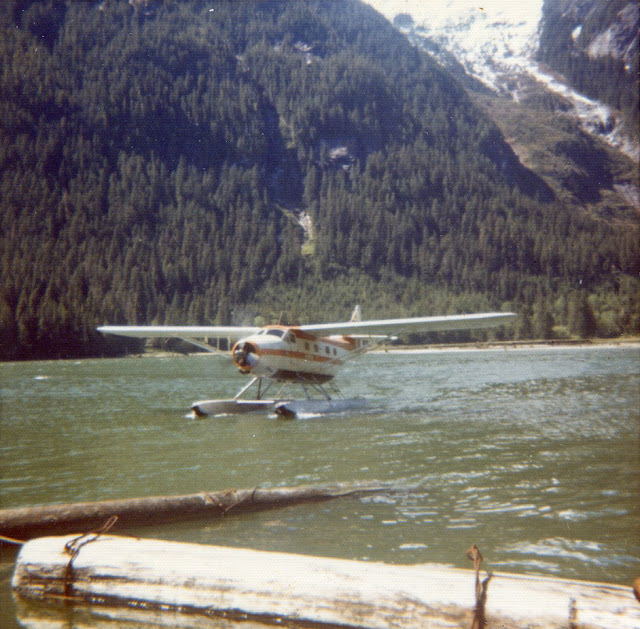
1944 Grumman G-21A Goose, c/n B-101, CF-VFU, FIFT. Dockside somewhere up Knight Inlet, B.C., Canada in spring 1969.

[1959 Kodak Retina IIIS (Type 027) rangefinder 35-mm roll film camera, s/n 86125, with Schneider-Kreuznach Retina-Xenon 50-mm f/1.9 Synchro Compur lens, s/n 6841319; Kodak Plus-X Pan (ISO 125/22°) 36-exposure black & white negative film]


© Copyright photograph by Uwe Kündrunar Scharnberg, 1969 / Stephan Alexander Scharnberg, March 2011


“The whole history of the Canadian North can be divided into two periods—before and after the aeroplane.”
Hugh L. Keenleyside, Deputy Canadian Minister of Mines and Resources, October 1949


Showing posts with label Knight Inlet. Show all posts

Thursday, March 8, 2012

1944 Grumman G-21A Goose, c/n B-101, CF-VFU, FIFT

1944 Grumman G-21A Goose, c/n B-101, CF-VFU, FIFT 

Taxiing to the floating dock somewhere up Knight Inlet, B.C., Canada in spring 1969.

Somewhere up Knight Inlet, B.C., Canada in spring 1969.

Starboard retractable float of 1944 Grumman G-21A Goose, c/n B-101, CF-VFU, FIFT.


(?) Possibly BCFP’s (British Columbia Forest Products) Crofton Pulp and Paper Mill, Crofton, Vancouver Island, B.C., Canada on return flight to Cowichan Bay after 10 days or two weeks treeplanting on the steep slopes at and near the head of Knight Inlet.

[1959 Kodak Retina IIIS (Type 027) rangefinder 35-mm roll film camera, s/n 86125, with Schneider-Kreuznach Retina-Xenon 50-mm f/1.9 Synchro Compur lens, s/n 6841319; Kodak Plus-X Pan (ISO 125/22°) 36-exposure black & white negative film]

© Copyright photographs by Uwe Kündrunar Scharnberg, 1969 / Stephan Alexander Scharnberg, March 2011

Tuesday, May 10, 2011

1946 Fairchild F-11-2 Husky, c/n 8, CF-SAQ, Island Airlines

1946 Fairchild F-11-2 Husky, c/n 8, CF-SAQ, Island Airlines, Campbell River, Vancouver Island, B.C., Canada, based at Campbell River Seaplane Base (CAE3), Tyee Spit, Campbell River, Vancouver Island, B.C.; powered by one 550-hp Alvis Leonides 503/8 supercharged nine-cylinder air-cooled radial piston engine with constant-speed three-blade propeller; floats; crew of two (pilot and co-pilot), ten passengers, STOL (short take-off and landing) bushplane; freight-loading door on each side, rear-loading cargo door/ramp; built by Fairchild Aircraft Ltd. (Canada), Longueuil, Québec; built as F-11-1 Husky, powered by one 450-hp Pratt & Whitney R-985-AN-14B Wasp Junior supercharged nine-cylinder air-cooled radial piston engine with variable-pitch two-blade Hamilton Standard propeller; CF-SAQ, Air Ambulance Service, Department of Public Health, Government of Saskatchewan, Regina, Saskatchewan in 1947; CF-SAQ, Austin Airways, Timmins, Ontario; CF-SAQ, Parsons Airways Northern Ltd., Flin Flon, Manitoba in late 1960s(?); nicknamed “Sad And Queer”; engine conversion by KCR Industries, Vancouver International Airport (YVR), Sea Island, Richmond, B.C. in 1966 or 1967(?); design rights acquired by Industrial Wings Ltd., subsidiary of Harrison Airways, Sea Island, Richmond, B.C., in 1970; CF-SAQ, West Coast Air Services Ltd., Sea Island, Richmond, B.C.; CF-SAQ, Island Airlines, Campbell River, Vancouver Island, B.C. on April 18, 1974, cancelled on June 17, 2001(?); apparently crashed in Strait of Georgia (according to one source); Island Airlines merged with Airwest Airlines, Gulf-Air Aviation, Haida Airlines, and West Coast Air Services Ltd. to form Air BC on December 1, 1980; one of three Huskys owned and operated by Island Airlines (one of the others was CF-EIR); one of only 12 ever built, of which six had their engines upgraded (F-11-1 Husky prototype, CF-BQC, c/n 1; CF-EIL/C-GCYV, c/n 2; CF-EIM-X/CF-EIM, c/n 3; CF-SAQ, c/n 8; CF-MAN, c/n 9; CF-EIR, c/n 12); six F-11-1 Huskys were not converted (CF-EIO, c/n 5; CF-EIP, c/n 6; CF-MAO, c/n 10; CF-BSH; CF-EIQ; CF-EIS).

Taxiing to a floating dock somewhere up Knight Inlet, B.C. sometime in the mid-1970s.

Seen from a right side window, Knight Inlet, B.C. sometime in the mid-1970s. 

[1959 Kodak Retina IIIS (Type 027) rangefinder 35-mm roll film camera, s/n 86125, with Schneider-Kreuznach Retina-Xenon 50-mm f/1.9 Synchro Compur lens, s/n 6841319]

© Copyright photographs by Uwe Kündrunar Scharnberg, 1974 / Stephan Alexander Scharnberg, March 2011

Monday, May 9, 2011

1944 Grumman G-21A Goose, c/n B-101, CF-VFU, FIFT

1944 Grumman G-21A Goose, c/n B-101, CF-VFU, FIFT dockside near the government wharf, Cowichan Bay, Vancouver Island, B.C., Canada in summer 1968.
1944 Grumman G-21A Goose, c/n B-101, CF-VFU, FIFT (Forest Industries Flying Tankers Ltd.), Sproat Lake, Vancouver Island, B.C., Canada, based at Sproat Lake, near Port Alberni, Vancouver Island, B.C.
  • powered by two 450-hp Pratt & Whitney R-985-AN-6 Wasp Junior supercharged nine-cylinder, single-row, air-cooled radial piston engines with constant-speed two-blade Hamilton Standard propellers


Dockside near the government wharf, Cowichan Bay in summer 1968. Uwe and his forestry crew planted seedlings on the steep slopes of Knight Inlet, part of TFL (Tree Farm Licence) 17. The men in the photograph are unidentified. My father can not remember their names. 

The following year, refitted with new engines, three-blade propellers, and retractable wingtip floats. Dockside somewhere up Knight Inlet, B.C., Canada in spring 1969.


1944 Grumman G-21A Goose, c/n B-101, CF-VFU, FIFT (Forest Industries Flying Tankers Ltd.), Sproat Lake, Vancouver Island, B.C., Canada, based at Sproat Lake, near Port Alberni, Vancouver Island, B.C.
  • gloss white and gloss red finish; in FIFT colour scheme (1960s)
  • powered by two 450-hp Pratt & Whitney R-985-AN-14B Wasp Junior supercharged nine-cylinder, single-row, air-cooled radial piston engines with constant-speed, full-feathering reversible-pitch, three-blade Hartzell propellers and propeller spinners
  • pilot, seven passengers, amphibian flying boat utility transport
  • high-wing cantilever monoplane; retractable wingtip float, outboard aileron, and inboard split-type trailing-edge flap on each wing; cruciform tail
  • bow hatch, aft passenger door with upward-swinging upper section & forward-swinging lower section on port side, aft emergency exit on starboard side, forward baggage compartment in bow, aft baggage compartment
  • twin-step amphibious flying boat hull, retractable conventional landing gear with steerable tailwheel

History:
  • built by The Grumman Aircraft Engineering Corporation, Bethpage, Long Island, New York, USA at Plant 2, Grumman Bethpage Airfield, Bethpage, Long Island, New York (F)
  • built as JRF-5 Goose (Model G-38), powered by two 450-hp Pratt & Whitney R-985-AN-6 Wasp Junior supercharged nine-cylinder, single-row, air-cooled radial piston engines with constant-speed two-blade Hamilton Standard propellers
  • delivered as BuNo 84806 to US Navy in November 1944
  • pilot, six passengers, amphibian flying boat military utility transport
  • aft passenger door with upward-swinging upper section & forward-swinging lower section and removable ladder on port side
  • fixed wing floats 
  • US Navy surplus in 1945
  • N62899, H.F. Keeler, Seattle, Washington, USA on June 5, 1952 and cancelled on March 9, 1967
  • converted to G-21A Goose
  • sold to FIFT (a consortium of five British Columbia forest companies formed by MacMillan Bloedel Limited, British Columbia Forest Products Limited, Pacific Logging Co. Ltd., Tahsis Company, and Western Forest Industries)
  • imported in 1967
  • CF-VFU, FIFT (Forest Industries Flying Tankers Ltd.), Sproat Lake, Vancouver Island, B.C., Canada on April 7, 1967 and cancelled on September 28, 2001
  • based at Sproat Lake, near Port Alberni, Vancouver Island, B.C.
  • gloss white and gloss red finish; in FIFT colour scheme (1960s)
  • based at Sproat Lake Seaplane Base (CAA9/CBT9)
  • powered by two 450-hp Pratt & Whitney R-985-AN-14B Wasp Junior supercharged nine-cylinder, single-row, air-cooled radial piston engines with constant-speed, full-feathering reversible-pitch, three-blade Hartzell propellers and propeller spinners
  • gloss white and gloss red finish with aluminum propeller spinners; in FIFT colour scheme (1960s)
  • retractable wingtip floats
  • used to transport timber companies’ personnel
  • my father Uwe Kündrunar Scharnberg was a forestry crew foreman with BCFP (British Columbia Forest Products Limited); he and his treeplanting crew flew with CF-VFU up the central British Columbia coast in the late 1960s and early 1970s from Cowichan Bay on Vancouver Island to Knight Inlet on the southern British Columbia Coast
  • re-registered as C-FVFU in 1977
  • FIFT (red conifer tree) logo on forward fuselage
  • also used for forest patrols, support, and spotter, lead-in aircraft for FIFT’s two water bombers (1945 Martin JRM-3 Mars, c/n 9264, BuNo 76820, C-FLYK, Philippine Mars and 1946 Martin JRM-3 Mars, c/n 9267, BuNo 76823, C-FLYL, Hawaii Mars) from 1980 to 1988
  • titled small FLYING TANKERS on centre fuselage; overall gloss yellow finish with gloss red & gloss white trim and aluminum propeller spinners; in FIFT colour scheme (circa 1984 ?)
  • tt 14,385 hours on April 21, 1997
  • C-FVFU, Flying Tankers Inc. (TimberWest Forest Ltd.), Sproat Lake, Vancouver Island, B.C., Canada on September 28, 2001 and cancelled on February 6, 2002
  • based at Sproat Lake Seaplane Base (CAA9/CBT9)
  • extended dorsal fin
  • leased to Klaus Dieter Martin, München, Bayern, Deutschland in September 2001
  • ferried from Victoria International Airport (YYJ/CYYJ), North Saanich, Vancouver Island, B.C., Canada on November 2, 2001; via Reykjavík Airport (RKV/BIRK), Reykjavík, Iceland and Wick Airport (WIC/EGPC), Wick, Caithness, Highland, Scotland on November 7, 2001; and Groningen Airport Eelde (GRQ/EHGG), Eelde, Drenthe, Netherlands to Sonderflughafen Oberpfaffenhofen (OBF/EDMO), Oberbayern, Bayern, Deutschland on November 9, 2001
  • over 15,000 airframe hours
  • C-FVFU, C-Tec Ltd., Saint John, New Brunswick, Canada on February 6, 2002 and cancelled on July 5, 2005
  • leased to European Coastal Airlines (European Coastal Airlines d.o.o.), Zagreb, Croatia
  • repainted at Kaposújlak Airport (LHKV), Kaposújlak, near Kaposvár, Somogy, Hungary
  • named Aline
  • titled www.EC-AIR.com on centre fuselage, EUROPEAN COASTAL AIRLINES on rear fuselage, and Thanks for Flying ECA on both sides of each retractable wingtip float; overall gloss white finish with gloss blue around engine cowlings into short cheat line, wingtip floats undersides, & flying boat hull underside, and aluminum propeller spinners; in ECA colour scheme (2002)
  • accident at Flughafen Salzburg (SZG/LOWS), Salzburg, Austria on March 4, 2002 arriving from Kaposújlak Airport (LHKV) when port landing gear collapsed after landing, landing gear and fuselage damaged, no injuries
  • repaired and refurbished at Flughafen Salzburg (SZG/LOWS) in March 2002
  • ferried from Flughafen Salzburg (SZG/LOWS) to Sonderflughafen Oberpfaffenhofen (OBF/EDMO) on April 9, 2002
  • refurbished in 2004
  • sold to Croatia on July 8, 2005
  • still carried Canadian registration C-FVFU in Croatia, despite registration cancelled and deleted from Transport Canada website on July 8, 2005, therefore registration no longer valid
  • should be carrying Croatian registration, prefixed with code 9A-
  • stored in Aerokluba Borovo hangar at Vukovar Borovo N Airport (LDOB), Borovo Naselje, Vukovar, Vukovar-Syrmia, Slavonia, Croatia in 2005, a settlement in the northwestern industrial part of Vukovar on the right bank of the river Danube, across from Serbia
  • airfield appears to be so small, it does not have fuel services
  • European Coastal Airlines, established by the Croatian company Obalna Kapitalna Ulaganja d.o.o., Zagreb, Croatia and ESPS (European SeaPlane Service GmbH), Landsberied, Oberbayern, Bayern, Deutschland in September 2000, several promotional flights with the Goose in 2000, AOC issued in 2001, put on hold after September 11, 2001, re-launched in 2007 when joined by a Croatian investor, then attempted to launch scheduled services in 2008, AOC expired, commercial operation announced three times, failed three times, never in commercial operation in Croatia despite much promotion for over ten years
  • plans were for the Goose to fly regular scheduled flights between Zagreb International Airport (ZAG/LDZA), Pleso, Croatia and Mali Lošinj on the island of Lošinj; Zagreb International Airport (ZAG/LDZA) and Rab on the island of Rab; Zagreb International Airport (ZAG/LDZA) and Rijeka on the Kvarner Gulf; Pula on the Istria peninsula and Rijeka (Flight Timetable valid on July 1, 2008 in planning phase and not yet activated)
  • European Coastal Airlines expansion plans reported in July 2010
  • fleet includes the Goose, two de Havilland Canada DHC-6 Twin Otters plus another six ordered, and 1979 Lake LA-4-200 Buccaneer, c/n 974, 9A-DLA
  • launch of expanded services announced for May 2011
  • this Goose is an Annex II aircraft under EASA, no commercial operations (JAR Ops 1) allowed, apparently reason why still carrying Canadian registration
  • new corporate website of European Coastal Airlines at www.ec-air.eu reported starting scheduled services in summer 2014, announced on March 3, 2014
  • ? new partners were AquaProject Group, Berlin, Deutschland; LEHEL Industrie Group, München, Bayern, Deutschland; and RUAG Aviation, Emmen, Luzern (LU), Schweiz
  • plans were to fly from small harbour base at Matejuska, Split, Croatia
  • destinations were to be: Ancona, Ancona (AN), Marche, Italia; Zagreb International Airport (ZAG/LDZA), Pula, Rab, Zadar, Matejuska in Split, Split Airport (SPU/LDSP) in Kaštela, Jelsa on the island of Hvar, Vis on the island of Vis, Korčula on the island of Korčula, Lastovo on the island of Lastovo, and Dubrovnik, all in Croatia
  • more bureaucratic delays then saw service starting on August 1, 2014 from Split Airport (SPU/LDSP) to surrounding islands; also plans to offer flights to Zagreb International Airport (ZAG/LDZA), Pula, and Zadar; and Ancona to Rab and Jelsa with amphibian 1977 de Havilland Canada DHC-6 Twin Otter Series 300, c/n 557, 9A-TOA that arrived at Split Airport (SPU/LDSP) on May 4, 2014 and since ferried to RUAG Aviation, Flughafen Bern (BRN/LSZB/LSMB), Belp, Bern (BE), Schweiz for modifications and maintenance required for Croation commercial operations
  • finally launched service, inaugurating four 13-minute daily flights from Split Airport (SPU/LDSP) to Jelsa on August 27, 2014 after receiving permits from the Croatian Civil Aviation Agency following a 13-year-old battle and delays with bureaucracy and red tape, becoming Europe’s first modern scheduled and commercial seaplane service
  • flights from Zagreb International Airport (ZAG/LDZA), Pula, Rab, and Zadar were also be added soon
  • after over 11 years as hangar queen in Aerokluba Borovo hangar at Vukovar Borovo N Airport (LDOB), pushed out of storage by Pannonia Aircraft Maintenance, Osijek Airport (OSI/LDOS), near Klisa, Osječko-Baranjska, Slavonia, Croatia on ? December 1, 2015 for preparation and maintenance before engines fired up
  • Pannonia Aircraft Maintenance (www.air-pannonia.hr) utilizes a mobile line maintenance van
  • Mike Ingram (Victoria Air Maintenance Ltd.) there on his first trip
  • imported in 2015
  • C-FMXW, Victoria Air Maintenance Ltd., Victoria International Airport (YYJ/CYYJ), North Saanich, Vancouver Island, B.C., Canada on October 23, 2015
  • still located in Croatia, but Victoria Air Maintenance Ltd. became the nominal owner until conformity and airworthiness issues resolved
  • still working on formally “conforming” the Goose to meet new EASA requirements for a fresh certificate of airworthiness, as Croatia only recently joined the EU (European Union) and came under EASA jurisdiction
  • Mike Ingram was planning a second trip to Croatia to finish up with the issues and the paperwork
  • grounded when its AOC temporarily withdrawn by the Croatian Civil Aviation Agency in August 2016, apparently because of safety concerns
  • European Coastal Airlines, now headquartered in Split, suspended operations in October 2016, the CEO announced that operations would resume in 2017, the company’s website and Facebook page had not been updated as of February 2017, the Commercial Court in Split initiated a pre-bankruptcy procedure on May 2, 2017 at the request of ECA filled on April 18, 2017, and no flights were resumed by end of July
  • apparently C-FMXW is slated to return to Canada

Dockside somewhere up Knight Inlet, B.C., Canada in spring 1969. Forestry crew are unidentified.


[1959 Kodak Retina IIIS (Type 027) rangefinder 35mm roll film camera, s/n 86125; Schneider-Kreuznach Retina-Xenon 50mm f/1.9 Synchro Compur lens, s/n 6841319; Kodak Plus-X Pan (ISO 125/22°) 36-exposure black & white negative film]

© Copyright photographs by Uwe Kündrunar Scharnberg, 1968–1969  
© Copyright words and photographs by Stephan Alexander Scharnberg, March 2011