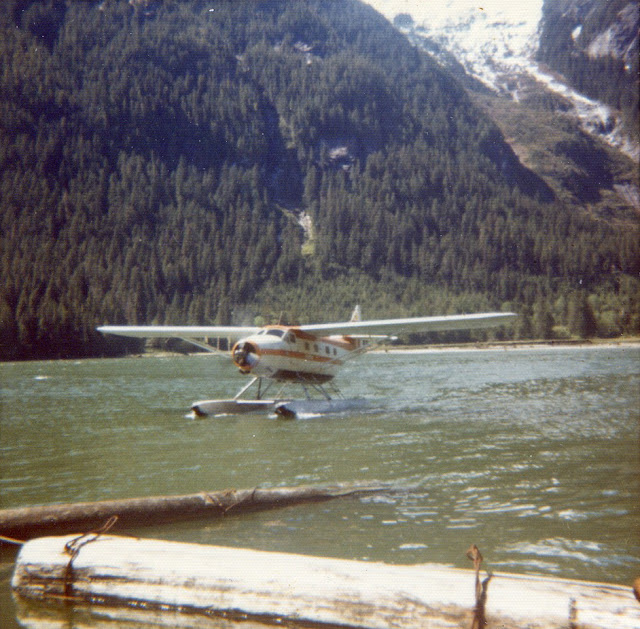
1944 Grumman G-21A Goose, c/n B-101, CF-VFU, FIFT. Dockside somewhere up Knight Inlet, B.C., Canada in spring 1969.

[1959 Kodak Retina IIIS (Type 027) rangefinder 35-mm roll film camera, s/n 86125, with Schneider-Kreuznach Retina-Xenon 50-mm f/1.9 Synchro Compur lens, s/n 6841319; Kodak Plus-X Pan (ISO 125/22°) 36-exposure black & white negative film]


© Copyright photograph by Uwe Kündrunar Scharnberg, 1969 / Stephan Alexander Scharnberg, March 2011


“The whole history of the Canadian North can be divided into two periods—before and after the aeroplane.”
Hugh L. Keenleyside, Deputy Canadian Minister of Mines and Resources, October 1949


Showing posts with label Airlines. Show all posts

Saturday, July 2, 2011

1961 de Havilland Canada DHC-2 Beaver Mk. I, c/n 1488, C-GIYV

1961 de Havilland Canada DHC-2 Beaver Mk. I, c/n 1488, C-GIYV, Tyax Air Services Ltd., Gold Bridge, B.C., Canada, based at Gold Bridge, B.C.; powered by one 450-hp Pratt & Whitney R-985-39 Wasp Junior supercharged nine-cylinder air-cooled radial piston engine with constant-speed two-blade Hamilton Standard propeller; floats; pilot, six passengers, STOL (short take-off and landing) bushplane; built by de Havilland Canada, Toronto, Ontario at Downsview, Ontario; delivered as Beaver AL Mk. I, XP823, Army Air Corps, British Army on September 15, 1961; first flight on November 21, 1961; to AAC on Deccember 6, 1961; declared surplus on May 5, 1987; C-GIYV, Richard J. Churchill, Edmonton, Alberta on August 24, 1988; C-GIYV, Ward Wamboldt, Edmonton, Alberta on July 6, 1990; C-GIYV, Coast Western Airlines Ltd., Garden Bay, B.C. on August 22, 1990; C-GIYV, Richard J. Churchill, Edmonton, Alberta on June 4, 1991, leased until November 30, 1991; owner registered since December 2, 1994.

Near the Harbour Air Seaplanes hangar, South Terminal, Vancouver International Airport (YVR), Sea Island, Richmond, B.C. at 12:14 pm, Friday, June 17, 2011.

[Nikon Coolpix L20, s/n 51002451, point-and-shoot digital camera]

© Copyright photograph by Stephan Alexander Scharnberg, June 2011 

Friday, June 24, 2011

1988 Conair Firecat, c/n 34, C-FJOH, “76”


1988 Conair Firecat, c/n 34, C-FJOH, “76”, Conair Group Inc., Abbotsford, B.C., Canada, operating as Conair Aviation, based at Abbotsford International Airport (YXX), Abbotsford, B.C.; powered by two 1,525-hp Wright R-1820-82WA Cyclone supercharged nine-cylinder air-cooled radial piston engines with constant-speed three-blade Hamilton Standard Hydromatic propellers; single-seat, airtanker/firefighter; retardant tank; rebuilt by Conair Aviation Ltd.; built as Grumman S2F-1 Tracker (Model G-89), c/n G-254, BuNo 133283 USN; crew of four (pilot, co-pilot, two detection systems operators), long-range deep-water ASW (anti-submarine warfare) surveillance and protection; built by The Grumman Aircraft Engineering Corporation, Bethpage, Long Island, New York, USA at Bethpage, Long Island, New York (F); converted to S2F-1T Tracker (multi-engine flight training and ASW training); redesignated as TS-2A Tracker in 1962; N424DF, California Department of Forestry, Mather, California; rebuilt as Conair Firecat; owner registered since September 24, 1991.

Preparing to depart for a fire at Seton Portage, B.C., situated between Pemberton and Lillooet. The 47th Annual Abbotsford International Airshow, Abbotsford International Airport (YXX), Abbotsford, B.C. at 10:39 am, Friday, August 7, 2009.

© Copyright video by Stephan Alexander Scharnberg, August 2009

1958 Conair Firecat, c/n 31, C-FEFX, “75”


1958 Conair Firecat, c/n 31, C-FEFX, “75”, Conair Group Inc., Abbotsford, B.C., Canada, operating as Conair Aviation, based at Abbotsford International Airport (YXX), Abbotsford, B.C.; powered by two 1,525-hp Wright R-1820-82WA Cyclone supercharged nine-cylinder air-cooled radial piston engines with constant-speed three-blade Hamilton Standard Hydromatic propellers; single-seat, airtanker/firefighter; retardant tank; converted by Conair Aviation Ltd.; built as Grumman S2F-1 Tracker (Model G-89), c/n G-527, BuNo 136618 USN; crew of four (pilot, co-pilot, two detection systems operators), long-range deep-water ASW (anti-submarine warfare) surveillance and protection; built by The Grumman Aircraft Engineering Corporation, Bethpage, Long Island, New York, USA at Bethpage, Long Island, New York (F); converted to S2F-1T Tracker (multi-engine flight training and ASW training); redesignated as TS-2A Tracker in 1962; N425DF, California Department of Forestry, Mather, California; converted to Conair Firecat; owner registered since October 11, 1991.

Preparing to depart for a fire at Seton Portage, B.C., situated between Pemberton and Lillooet. The 47th Annual Abbotsford International Airshow, Abbotsford International Airport (YXX), Abbotsford, B.C. at 10:32 am, Friday, August 7, 2009.

© Copyright video by Stephan Alexander Scharnberg, August 2009

1957 Conair Firecat, c/n 19, C-FOPY, “69”


1957 Conair Firecat, c/n 19, C-FOPY, “69”, Conair Group Inc., Abbotsford, B.C., Canada, operating as Conair Aviation, based at Abbotsford International Airport (YXX), Abbotsford, B.C.; powered by two 1,525-hp Wright R-1820-82WA Cyclone supercharged nine-cylinder air-cooled radial piston engines with constant-speed three-blade Hamilton Standard Hydromatic propellers; single-seat, airtanker/firefighter; retardant tank; converted by Conair Aviation Ltd.; built as Grumman CS2F-1 Tracker (Model G-103), c/n DHC24; crew of four (pilot, co-pilot, two detection systems operators), long-range deep-water ASW (anti-submarine warfare) surveillance and protection/with decommission of aircraft carrier HMCS Bonaventure, became shore-based and given role change, crew of three (pilot, co-pilot, Airborne Electronic Sensor Operator), shallow-water anti-shipping surveillance, northern sovereignty surveillance, fisheries protection and maritime patrol; built by de Havilland Canada, Toronto, Ontario at Downsview, Ontario; taken on strength as 1525 RCN in 1957; renumbered as 12125 CAF in June 1970; redesignated as CP-121 Tracker; not clear if CAF serial marked before being struck off; struck off strength on November 12, 1970; CF-IOF, later CF-OPY, “58”, Ontario Ministry of Natural Resources from September 28, 1978; C-FOPY, converted to Conair Firecat by May 1985; registration as CS2F-1 Tracker cancelled on September 24, 1991; re-registered as Conair Firecat the same day.

1988 Conair Firecat, c/n 34, C-FJOH, “76”, Conair Group Inc., Abbotsford, B.C., Canada, operating as Conair Aviation, based at Abbotsford International Airport (YXX), Abbotsford, B.C.; powered by two 1,525-hp Wright R-1820-82WA Cyclone supercharged nine-cylinder air-cooled radial piston engines with constant-speed three-blade Hamilton Standard Hydromatic propellers.

1958 Conair Firecat, c/n 31, C-FEFX, “75”, Conair Group Inc., Abbotsford, B.C., Canada, operating as Conair Aviation, based at Abbotsford International Airport (YXX), Abbotsford, B.C.; powered by two 1,525-hp Wright R-1820-82WA Cyclone supercharged nine-cylinder air-cooled radial piston engines with constant-speed three-blade Hamilton Standard Hydromatic propellers.

Three Conair Firecats preparing for departure. In all, four of these vintage birds left one after the other between 10:30 and 10:44 am for a fire at Seton Portage, B.C., situated between Pemberton and Lillooet. The 47th Annual Abbotsford International Airshow, Abbotsford International Airport (YXX), Abbotsford, B.C. at 10:31 am, Friday, August 7, 2009.

© Copyright video by Stephan Alexander Scharnberg, August 2009

Thursday, June 23, 2011

Conair Firecats at their Abbotsford Air Tanker Base


1988 Conair Firecat, c/n 34, C-FJOH, “76”, Conair Group Inc., Abbotsford, B.C., Canada, operating as Conair Aviation, based at Abbotsford International Airport (YXX), Abbotsford, B.C.; powered by two 1,525-hp Wright R-1820-82WA Cyclone supercharged nine-cylinder air-cooled radial piston engines with constant-speed three-blade Hamilton Standard Hydromatic propellers; single-seat, airtanker/firefighter; retardant tank; rebuilt by Conair Aviation Ltd.; built as Grumman S2F-1 Tracker (Model G-89), c/n G-254, BuNo 133283 USN; crew of four (pilot, co-pilot, two detection systems operators), long-range deep-water ASW (anti-submarine warfare) surveillance and protection; built by The Grumman Aircraft Engineering Corporation, Bethpage, Long Island, New York, USA at Bethpage, Long Island, New York (F); converted to S2F-1T Tracker (multi-engine flight training and ASW training); redesignated as TS-2A Tracker in 1962; N424DF, California Department of Forestry, Mather, California; rebuilt as Conair Firecat; owner registered since September 24, 1991.

1957 Conair Firecat, c/n 19, C-FOPY, “69”, Conair Group Inc., Abbotsford, B.C., Canada, operating as Conair Aviation, based at Abbotsford International Airport (YXX), Abbotsford, B.C.; powered by two 1,525-hp Wright R-1820-82WA Cyclone supercharged nine-cylinder air-cooled radial piston engines with constant-speed three-blade Hamilton Standard Hydromatic propellers; single-seat, airtanker/firefighter; retardant tank; converted by Conair Aviation Ltd.; built as Grumman CS2F-1 Tracker (Model G-103), c/n DHC24; crew of four (pilot, co-pilot, two detection systems operators), long-range deep-water ASW (anti-submarine warfare) surveillance and protection/with decommission of aircraft carrier HMCS Bonaventure, became shore-based and given role change, crew of three (pilot, co-pilot, Airborne Electronic Sensor Operator), shallow-water anti-shipping surveillance, northern sovereignty surveillance, fisheries protection and maritime patrol; built by de Havilland Canada, Toronto, Ontario at Downsview, Ontario; taken on strength as 1525 RCN in 1957; renumbered as 12125 CAF in June 1970; redesignated as CP-121 Tracker; not clear if CAF serial marked before being struck off; struck off strength on November 12, 1970; CF-IOF, later CF-OPY, “58”, Ontario Ministry of Natural Resources from September 28, 1978; C-FOPY, converted to Conair Firecat by May 1985; registration as CS2F-1 Tracker cancelled on September 24, 1991; re-registered as Conair Firecat the same day.

1958 Conair Firecat, c/n 31, C-FEFX, “75”, Conair Group Inc., Abbotsford, B.C., Canada, operating as Conair Aviation, based at Abbotsford International Airport (YXX), Abbotsford, B.C.; powered by two 1,525-hp Wright R-1820-82WA Cyclone supercharged nine-cylinder air-cooled radial piston engines with constant-speed three-blade Hamilton Standard Hydromatic propellers; single-seat, airtanker/firefighter; retardant tank; converted by Conair Aviation Ltd.; built as Grumman S2F-1 Tracker (Model G-89), c/n G-527, BuNo 136618 USN; crew of four (pilot, co-pilot, two detection systems operators), long-range deep-water ASW (anti-submarine warfare) surveillance and protection; built by The Grumman Aircraft Engineering Corporation, Bethpage, Long Island, New York, USA at Bethpage, Long Island, New York (F); converted to S2F-1T Tracker (multi-engine flight training and ASW training); redesignated as TS-2A Tracker in 1962; N425DF, California Department of Forestry, Mather, California; converted to Conair Firecat; owner registered since October 11, 1991.

Three Conair Firecats preparing for departure. In all, four of these vintage birds left one after the other between 10:30 and 10:44 am for a fire at Seton Portage, B.C., situated between Pemberton and Lillooet. The 47th Annual Abbotsford International Airshow, Abbotsford International Airport (YXX), Abbotsford, B.C. at 10:30 am, Friday, August 7, 2009.

© Copyright video by Stephan Alexander Scharnberg, August 2009

Wednesday, June 15, 2011

2007 Schweizer 300CBi (269C-1), c/n 0322, C-FSEV

2007 Schweizer 300CBi (269C-1), c/n 0322, C-FSEV, British Columbia Helicopters Limited, Langley, B.C., Canada, based at Abbotsford International Airport (YXX), Abbotsford, B.C.; powered by one 180-hp Lycoming HIO-360-G1A fuel-injected four-cylinder, horizontally-opposed, air-cooled piston engine with three-blade main rotor and two-blade tail rotor; side-by-side instructor and student, light utility/trainer; built by Schweizer Aircraft Corporation, Horseheads, New York, USA at Elmira, New York; N86G, Schweizer Aircraft Corporation; imported in 2007; owner registered since December 18, 2007.

The 48th Annual Abbotsford International Airshow, Abbotsford International Airport (YXX), Abbotsford, B.C. at 9:27 am, Saturday, August 14, 2010.

© Copyright photograph by Stephan Alexander Scharnberg, August 2010

Saturday, June 11, 2011

1972 Bell 206B JetRanger II, c/n 763, CF-ALF, Alpine Helicopters


1972 Bell 206B JetRanger II, c/n 763, CF-ALF, Alpine Helicopters Ltd., Kelowna, B.C., Canada, based at Kelowna, B.C.; powered by one 400-shp Allison 250-C20 turboshaft engine with two-blade main rotor and two-blade tail rotor; skids; pilot, four-passengers or equivalent cargo, multi-purpose utility transport; built by Bell Helicopter Company, Textron Inc., Hurst, Texas, USA; owner registered since March 28, 1972; re-registered as C-FALF; registration cancelled on July 25, 1996.

The Annual Duncan Flying Club Fly-In, Duncan Airport (DUQ), Duncan, Vancouver Island, B.C. on Sunday, June 10, 1979.

[Agfa Agfamatic 100 sensor viewfinder 126 cartridge film camera, 42.1-mm f/11 lens; Agfa Agfacolor Special CNS 126 20 DIN/80 ASA 20-exposure colour negative cartridge film]

© Copyright photographs by Stephan Alexander Scharnberg, June 1979

1978 Piper PA-31-325 Navajo C/R, c/n 31-7812085, C-GDFR

1978 Piper PA-31-325 Navajo C/R, c/n 31-7812085, C-GDFR, Island Express Air Inc., Abbotsford, B.C., Canada, based at Abbotsford International Airport (YXX), Abbotsford, B.C.; powered by one each 325-hp Lycoming TIO-540-F2BD/LTIO-540-F2BD turbocharged fuel-injected six-cylinder, horizontally-opposed, air-cooled piston engine with counter-rotating, constant-speed three-blade Hartzell propellers; retractable landing gear; pilot, nine passengers, utility transport; built by Piper Aircraft, Vero Beach, Florida, USA at Lock Haven, Pennsylvania; N51DW, Desert Aviation Services Inc., Las Vegas, Nevada certificate issued on April 16, 1997, cancelled on April 6, 1998; imported in 1998; C-GDFR, Dynamic Flight Services Inc., Calgary, Alberta on April 14, 1998, cancelled on November 16, 2007; C-GDFR, BCWest Air Inc., Abbotsford, B.C. on November 26, 2007, cancelled on June 19, 2008; C-GDFR, BCWEST Air Inc., Nanaimo, Vancouver Island, B.C. on June 27, 2008, cancelled on December 12, 2008; C-GDFR, Island Express Air Inc., Lantzville, Vancouver Island, B.C. on May 22, 2009, cancelled on August 20, 2009; owner re-registered since August 20, 2009.

The 48th Annual Abbotsford International Airshow, Abbotsford International Airport (YXX), Abbotsford, B.C. on Saturday, August 14, 2010 at 9:35 am.

[1984 Nikon FE2 SLR 35-mm roll film camera, s/n 1816483, with Nikkor AI 50-mm f/1.8 lens, s/n 2336591, and 52-mm polarizing filter; Fujifilm Fujicolor Pro 160S 36-exposure colour negative film]

© Copyright photograph by Stephan Alexander Scharnberg, August 2010

Friday, June 10, 2011

Royal Canadian Air Cadets, 1975–1979

The sole surviving shoulder patch from my “battle dress”-style (short waist coat) blue-grey wool uniform, the 1941–1976 issue. Officially the colour was known as Azure Blue.

The “battle dress”-style blue-grey wool uniform was changed to a CAF rifle green safari-style uniform. The style and weight were more suited to the indoors of the cadet halls and the summer training climate and temperatures. The first of these were issued to squadrons starting in 1978. Although the old blue-grey wool uniforms were hot in the summer, but warm in the winter, I did not like the change from the traditional WW II-era RCAF style to one that made the male cadets look like little wussies and sissies, and it was not flattering to the females either. The current blue Air Cadet uniform is a great improvement on the green style and a big step in the right direction. Our head gear was the “Wedge Cap”, or “Wedgie” as we named them, worn with a slight tilt to the right side, one inch above the right ear, and centred forward and aft on the head, the front one inch above the eye brow. It was designed with pull-down ear flaps and neck protection, useful in the cold Canadian winters on windy and icy parade squares.

About one month before my thirteenth birthday, I joined the local RCAirC (Royal Canadian Air Cadets) unit, 744 Cowichan Squadron, enlisting for four years, sometime September 1975 to the early autumn of 1979 just after the start of Grade 11, with the aim of receiving and achieving flight training through their glider and small aircraft familiarization programs. My parents were not too thrilled about the uniform and the military aspects of this, as father had experienced mandatory enlistment in the Hitler Jugend (Hitler Youth) during the wartime Nazi years, from age 12 in March 1941 to the end of hostilities in early May 1945, but nonetheless allowed me, and a year later my brother, to enlist.

Since childhood I wanted to pursue my dream of becoming either a bushplane or a commercial pilot. Flying was it. I did not care much for the military discipline, although I always followed commands. But I only attained the rank of Corporal.

In those years the squadron was based in the old St. Ann Rectory, a former Catholic convent and girls residence school for many Cowichan natives for 100 years, built by the Sisters of St. Ann in 1864, next to the Stinesen’s farm and the little white St. Ann’s Church, Quamichan, 1775 Tzouhalem Rd., almost at the foot of and in the shadows of Mt. Tzouhalem and its white cross overlooking Cowichan Bay. My Blackfoot First Nations uncle, John McHugh, (Siksika Nation in Gleichen, Alberta) is buried at St. Ann’s Church. He took his own life with a hand gun in the early 1970s. He had experienced the horrors of a residential school. Today St. Ann Rectory is known as Providence Farm (where for a time, or maybe still, the annual Island Music Festival annually takes place).

A girl I knew and liked since Grade One, Jennifer Brain (now Lally), joined during my last year of enlistment. A few other cadets I remember are a Stinesen daughter, Simone Desautels and her brother, Peter Norie, Fiona Barr and her brother, Greg Anderson, Sabina Braun, Richard Leduc, Ken Dzuba, and Stuart Lumgair.

Nanaimo Airport (YCD), Cassidy (near Nanaimo), Vancouver Island, B.C., Canada was where the weekend familiarization flights took place on a few weekends in late spring, summer, and autumn, typically from late March to early November, weather-permitting. This included flying as a passenger in the rear seat of the tandem two-seat Cessna L-19A-CE Bird Dog or Bellanca 8GCBC Scout tow plane and in the front seat of one of the tandem two-seat Schweizer SGU 2-22C, Schweizer SGU 2-22E, or Schweizer SGS 2-33A gliders, participation in the ground operations which included positioning the gliders for take-off and retrieving them after landing, signalling between the tow plane and the glider, holding up and running with the right wing tip until the glider picked up sufficient take-off speed, and retrieving tow ropes dropped by the tow plane prior to it landing, from the grass strip between Runway 16/34 and the parallel tarmac, hooking the tow rope to the tow plane and the glider, and lollipop duty, holding up a big round orange day-glo aluminum sign to stop taxiing aircraft until the tow plane or the glider had passed and landed, at the edge of Taxiway Able, Runway 34, or Taxiway Bravo, Runway 16, depending on the wind direction indicated by the orange wind sock situated on the grass strip. On one occasion I was in the enviable position of stopping a just-arrived Douglas DC-3 from entering the taxiway and crossing the incoming glider’s landing path. I can still see the pilot and co-pilot looking down at me, and the passengers peering from the cabin windows. The Air Cadet League provided administrative and recreational support at these events. This reduced the workload of the CAF flying and training staff and the Air Cadet squadron commanders. 

I attended two or three extended field trips to NAS (Naval Air Station) Whidbey Island, near Oak Harbor, Washington, USA including a tour of the Boeing 747 factory at Paine Field (PAE), Everett, Washington. There was also an excursion to the South Terminal at Vancouver International Airport (YVR), Sea Island, Richmond, B.C. which included a tour of some hangars and clambering inside the sickly green Grumman G-73 Mallard amphibious flying boat, CF-HUB, or was it the Grumman G-73 Mallard, CF-HPU ?, seemingly a little lost and forlorn, parked out on the weed-plagued tarmac.

In the summer of 1978, I attended the Basic Training camp at CFB Penhold near Red Deer, Alberta. We flew Victoria–Vancouver–Edmonton with a Pacific Western Airlines Boeing 737-275 and then bumped our way to the base, on hard, vinyl benches in a dark green Canadian Armed Forces Bluebird bus. I neglected to use an airport washroom when an officer gave us the opportunity, thinking I was not in need until the base. I sat suffering in silence and anguish with a full bladder and urine erection, luckily on a last row bench at a window, covering up with my blue grey wool jacket. We were underway for a little over two hours.

I remember flying with the 1975 Boeing 737-275(A), c/n 20959/395, C-GCPW, “741”, PWA, Calgary, Alberta, Canada; powered by two 14,500-lbs thrust Pratt & Whitney JT8D-9A(HK3) low-bypass turbofan engines; crew of two (pilot and co-pilot), seating configuration Y117 (economy-class), short- to medium-range, narrow-body airliner; built by The Boeing Company, Seattle, Washington, USA at Renton, Washington; first flight on January 22, 1975; delivered on February 24, 1975; N126AW, “126”, America West Airlines, Phoenix, Arizona on June 20, 1983; C-GCPW, Canadian Airlines International, Calgary, Alberta on November 12, 1987; C-GCPW, America West Airlines, Phoenix, Arizona on May 10, 1989, leased; C-GCPW, Canadian Airlines International, Calgary, Alberta on January 6, 1998; C-GCPW, “541”, Air Canada, Montréal, Québec on March 8, 2001, merged; full Air Canada colour scheme; last regular flight in October 2001; ferried from Calgary International Airport (YYC), Calgary, Alberta to Opa-locka Airport (OPF), Miami-Dade County, Florida on April 10, 2003; broken up by BlueSide Metals at Opa-locka Airport (OPF), Miami-Dade County, Florida; scrapped.

My summer training highlight was flying in a de Havilland Canada CC-138 Twin Otter through a series of loops and hammerhead stalls high over the Alberta prairie, the blue skies sparsely battened with a few high-altitude puffs of straggling cloud. With the G forces through the manoeuvres our wedgies floated from our heads to slide a moment along the cabin ceiling.

As best as I can recall, it was the 1971 de Havilland Canada CC-138 Twin Otter (military version of -300 Series), c/n 309, 13807/807, CAF; powered by two 680-shp Pratt & Whitney Canada PT6A-27 turboprop engines with constant-speed, full-feathering reversible-pitch, three-blade Hartzell propellers; crew of two (pilot and co-pilot), 18 passengers, STOL (short take-off and landing) SAR (search and rescue)/Arctic utility transport; built by de Havilland Canada, Toronto, Ontario, Canada at Downsview, Ontario; taken on strength on September 17, 1971; No. 440 Squadron, CFB Namao, Edmonton, Alberta; struck off on May 5, 1987; she was used by crew from reserve unit No. 418 Squadron at time of the crash on June 14, 1986, searching for a civilian SAR aircraft that had gone down looking for an overdue light plane; the aircraft was destroyed flying into the side of a mountain, killing all on board: pilot Captain Ted Kates, co-pilot Captain Wayne Plumtree, and six observers; according to the official accident report, the crash was caused by a freak optical illusion; the colour of the rocks in the mountain combined with the sun angle at the time of the crash made a large ledge impossible to see; the crash location is 74 kilometres (46.3 miles) west of Calgary, Alberta.

I was a day dreamer, having difficulty focusing on math and theory knowledge and the skills necessary to be able to learn all the technical stuff. I could not grasp the navigation calculation formulas. I scored poor marks on the mathematical and navigational problems and questions of the flying ground school lessons and exam. I failed the exams as a prerequisite for applying to glider school training and beyond.

At about the same time I did not pass the exacting medical physicals. I notoriously fainted during the doctor appointments and anytime there was any talk of medical-related subjects and issues.

I quit Air Cadets a week after washing out, my long-held dreams of flying dashed. I was in a blue funk.

In time I applied my focus in a new direction. Camphill was to be just over the horizon.

© Copyright scanned image by Stephan Alexander Scharnberg, June 2011

Thursday, June 9, 2011

1970 Bell 206B JetRanger II, c/n 194, C-GVTM

1969 Bell 206B JetRanger II, c/n 194, C-GVTM, Far West Helicopters Ltd., Chilliwack, B.C., Canada, based at Chilliwack Airport (YCW), Chilliwack, B.C.; powered by one 400-shp Allison 250-C20 turboshaft engine with two-blade main rotor and two-blade tail rotor; skids; pilot, four passengers or equivalent cargo, multi-purpose utility transport; built by Bell Helicopter Company, Textron Inc., Hurst, Texas, USA; built as 206A JetRanger, powered by one 317-shp Allison 250-C18 turboshaft engine with two-blade main rotor and two-blade tail rotor; converted to 206B JetRanger II with upgrade kit in 1970; N4038G, Tundra Copters Inc., Fairbanks, Alaska on May 8, 1975, cancelled on March 14, 1979; imported in 1979; C-GVTM, Rotortech Helicopters, Surrey, B.C. cancelled on April 23, 1986; C-GVTM, Capital Helicopters Inc., Delta, B.C. cancelled on March 14, 1988; C-GVTM, Sandspit Heli-Jet Ltd., Sandspit, Haida Gwaii, B.C. on April 25, 1988, cancelled on June 8, 1990; C-GVTM, Cariboo Chilcotin Helicopters, Lillooet, B.C. on June 8, 1990, cancelled on June 18, 1991; C-GVTM, Pacific Rim Helicopters Ltd., Delta, B.C. on September 22, 1993, cancelled on May 6, 1994; C-GVTM, Alpen Helicopters Ltd., Langley, B.C. on May 6, 1994, cancelled on September 19, 1996; owner registered since September 19, 1996.

Hope Aerodrome (YHE), Hope, B.C. on Tuesday, August 4, 2009 at 12:34 pm.

[Casio Exilim EX-Z20 point-and-shoot 8.1 MP digital camera, 38–114-mm f/3.1–5.9 lens]

© Copyright photograph by Stephan Alexander Scharnberg, August 2009

Wednesday, June 8, 2011

1986 Raytheon Beechcraft 1900C, c/n UB-66, C-FPCX

1986 Raytheon Beechcraft 1900C, c/n UB-66, C-FPCX, Pacific Coastal Airlines Ltd. (Jim Pattison’s airline), Sea Island, Richmond, B.C., Canada, based at South Terminal, Vancouver International Airport (YVR), Sea Island, Richmond, B.C.; powered by two 1,100-shp Pratt & Whitney Canada PT6A-65B turboprop engines with constant-speed four-blade Hartzell propellers; crew of two (pilot and co-pilot), 19 passengers, regional airliner; built by Raytheon Company, Lexington, Massachusetts, USA at Wichita, Kansas; N3044C; N823BE, BEX Business Express, Portsmouth, New Hampshire on December 30, 1986; N823BE, GECC in June 1996, returned; F-OJAS, Aero Services, France on May 20, 1997; F-GTOT, Regourd Aviation, France in June 1997, leased; F-GTOT, Darta Aero Charter, France in June 1997, leased; F-GTOT, Danish Air Transport in December 1997, leased; OY-JRF, Danish Air Transport, Denmark on April 21, 1998; imported in 2006; owner registered since June 20, 2006.

Engineless and partially dismantled, South Terminal, Vancouver International Airport (YVR), Sea Island, Richmond, B.C. on Tuesday, December 21, 2010 at 11:22 am.

[1984 Nikon FE2 SLR 35-mm roll film camera, s/n 1816483, with Nikkor AI 50-mm f/1.8 lens, s/n 2336591, and 52-mm polarizing filter; Kodak Gold 200 36-exposure colour negative film]

© Copyright photograph by Stephan Alexander Scharnberg, December 2010

Friday, June 3, 2011

Current fate of 1944 Grumman G-21A Goose, c/n B-101, C-FVFU, Aline, European Coastal Airlines

Anyone wondering as to the fate of the 1944 Grumman G-21A Goose, c/n B-101, C-FVFU, Aline, European Coastal Airlines? She was most recently refurbished in 2004. Then she was sitting in a hangar at Vukovar Borovo N Airport (DOB), Borovo Naselje, Slavonia, Croatia, a settlement in the northwestern industrial part of Vukovar, Vukovar-Syrmia, Croatia, on the right bank of the river Danube across from Serbia. There are five photos of her in that hangar, dated October 20, 2008. The airfield appears to be so small it does not have fuel services. Founded in 2000, the company was put on hold after September 11, 2001, then launched scheduled services in 2008. Their fleet at this point consists of three seaplanes, apparently including the Grumman G-21A Goose, and they operate on routes around the Croatian islands in the Adriatic Sea.

Monday, May 30, 2011

1966 Bell 204B, c/n 2043, C-FOKY, Alpine Helicopters

1966 Bell 204B, c/n 2043, C-FOKY, Alpine Helicopters Ltd., Kelowna, B.C., Canada, based in Kelowna, B.C.; powered by one 1,100-shp Lycoming T53-L-11A turboshaft engine with two-blade main rotor and two-blade tail rotor; skids; crew of one or two (pilot, co-pilot), 8–9 passengers or equivalent cargo, multi-purpose utility transport; built by Bell Helicopter Company, Textron Inc., Hurst, Texas, USA; registered on May 26, 1975, cancelled on May 16, 1988; C-FOKY, Eagle Copters Ltd., Calgary, Alberta on May 5, 1988, cancelled on May 19, 1989; C-FOKY, Vancouver Island Helicopters Ltd., Sidney, Vancouver Island, B.C. on May 19, 1989, cancelled on August 11, 1989; C-FOKY, Les Hélicoptères Abitibi Ltée, La Sarre, Québec on August 24, 1989, cancelled on February 20, 1990; C-FOKY, Nationwide Helicopters Ltd., De Winton, Alberta on February 20, 1990, cancelled on March 3, 1992; C-FOKY, Conair Aviation Ltd., Abbotsford, B.C., operated as Frontier Helicopters, on April 28, 1992, cancelled on June 5, 1996; C-FOKY, Denendeh Helicopters Ltd., Hay River Dene Reserve, NWT on July 16, 1996, cancelled on January 23, 1997; C-FOKY, Venture Helicopters (M.K.C.) Incorporated, Calgary, Alberta on May 27, 1997, cancelled on April 20, 1998; C-FOKY, Provincial Helicopters Ltd., Lac Du Bonnet, Manitoba on May 26, 1998, cancelled on May 21, 2004; C-FOKY, Provincial Helicopters Ltd., Lac Du Bonnet, Manitoba on September 3, 2004, cancelled on June 3, 2005; C-FOKY, Hélicoptères Panorama Ltée/Panorama Helicopters Ltd., Alma, Québec on June 3, 2005, cancelled on May 26, 2006; C-FOKY, Hélicoptères Panorama Ltée/Panorama Helicopters Ltd., Alma, Québec on August 23, 2006, cancelled on May 26, 2010; C-FOKY, Hélicoptères Panorama Ltée/Panorama Helicopters Ltd., Alma, Québec on February 3, 2011, cancelled on March 24, 2011; C-FOKY, Eagle Copters Ltd., Calgary, Alberta on March 24, 2011, cancelled on June 16, 2011; C-FOKY, Black Swan Helicopters Ltd., Berwyn, Alberta on June 16, 2011.

The Annual Duncan Flying Club Fly-In, Duncan Airport (DUQ), Duncan, Vancouver Island, B.C. on Sunday, June 10, 1979.

[Agfa Agfamatic 100 sensor viewfinder 126 cartridge film camera, 42.1-mm f/11 lens; Agfa Agfacolor Special CNS 126 20 DIN/80 ASA 20-exposure colour negative cartridge film]

© Copyright photographs by Stephan Alexander Scharnberg, June 1979

Thursday, May 19, 2011

1996 Bombardier Learjet 31A, c/n 31A-120, C-GHJU

1996 Bombardier Learjet 31A, c/n 31A-120, C-GHJU, Helijet International Inc., Sea Island, Richmond, B.C., Canada, operated for BCAS (British Columbia Ambulance Service), based at South Terminal, Vancouver International Airport (YVR), Sea Island, Richmond, B.C.; powered by two 3,500-lbs thrust Garrett AiResearch TFE731-2-3B turbofan engines; crew of two (pilot and co-pilot), eight passengers, business aviation/air ambulance; built by Bombardier Aerospace, Dorval, Québec at Wichita, Kansas, USA; I-TYKE, Eurofly Service S.p.A., Aeroporto “Sandro Pertini”, Caselle Torinese, Turin (TO), Piedmont, Italy in 1996; N200TJ, JRW Aviation, Anchorage, Alaska on February 13, 2006; imported in 2007; owner registered since February 23, 2007.

The 48th Annual Abbotsford International Airshow, Abbotsford International Airport (YXX), Abbotsford, B.C. on Saturday, August 14, 2010 at 10:03 am.

[1984 Nikon FE2 SLR 35-mm roll film camera, s/n 1816483, with Nikkor AI 50-mm f/1.8 lens, s/n 2336591, and 52-mm polarizing filter; Fujifilm Fujicolor Pro 160S 36-exposure colour negative film]

© Copyright photograph by Stephan Alexander Scharnberg, August 2010

Wednesday, May 18, 2011

1968 Cessna 180H Skywagon, c/n 180-51973, C-GYVA

1968 Cessna 180H Skywagon, c/n 180-51973, C-GYVA, Ocean Air Floatplanes Inc., Sidney, Vancouver Island, B.C., Canada, based at Victoria Airport Water Aerodrome (CAP5), Patricia Bay, Sidney, Vancouver Island, B.C.; powered by one 230-hp Continental O-470-R six-cylinder, horizontally-opposed, air-cooled piston engine with constant-speed two-blade McCauley propeller; Edo 2960 floats; Horton STOL kit; pilot, five passengers, utility transport; built by Cessna Aircraft Company, Wichita, Kansas, USA; imported in 1968; C-FXCQ, Sabourin Lake Airways Ltd., Cochenour, Ontario cancelled on June 10, 1983; C-FXCQ, Whitehead Moose, Pikangikum, Ontario on March 16, 1984, cancelled on December 11, 1987; C-FXCQ, Howey Bay Camps Limited, Red Lake, Ontario on December 11, 1987, cancelled on December 11, 1989; C-GYVA, Alvin Bancarz, Sherwood Park, Alberta on June 27, 2002, cancelled on September 4, 2002; C-GYVA, Canadian Institute of Aviation Technology Inc., Kelowna, B.C., operating as Air Hart Aviation, on September 16, 2002, cancelled on December 22, 2003; owner registered since January 20, 2004.

Just arrived, taxiing past the Harbour Air and West Coast Air seaplane docks for a Coal Harbour marina near the foot of Denman St., north of W. Georgia Street in the West End, Vancouver Harbour Water Airport (CXH), Vancouver, B.C. on Tuesday, August 3, 2010 at 11:16 am. 

Taxiing out at 11:32 am.

[Casio Exilim EX-Z20 point-and-shoot 8.1 MP digital camera, 38–114-mm f/3.1–5.9 lens]

© Copyright photographs by Stephan Alexander Scharnberg, August 2010

Tuesday, May 17, 2011

2000 Raytheon Beech B300 Super King Air 350, c/n FL-273, C-FVKC

2000 Raytheon Beech B300 Super King Air 350, c/n FL-273, C-FVKC, Carson Air Ltd., Kelowna, B.C., Canada, operated for BCAS (British Columbia Ambulance Service), based at Kelowna International Airport (YLW), Kelowna, B.C.; powered by two 1,050-shp Pratt & Whitney Canada PT6A-60A turboprop engines with constant-speed four-blade Hartzell propellers; retractable landing gear; crew of two (pilot and co-pilot), maximum 13 passengers, utility transport/air ambulance; built by Raytheon Company, Raytheon Aircraft Co., Wichita, Kansas, USA at Wichita, Kansas; N4473E, Sun Aviation Inc., Wichita, Kansas on May 5, 2000, cancelled on June 30, 2000; exported to Denmark; OY-JVL, Bulgari Operational Services ApS, Copenhagen, Denmark; imported in 2007; owner registered since March 22, 2007.

The 48th Annual Abbotsford International Airshow, Abbotsford International Airport (YXX), Abbotsford, B.C. on Saturday, August 14, 2010 at 10:02 am.

[1984 Nikon FE2 SLR 35-mm roll film camera, s/n 1816483, with Nikkor AI 50-mm f/1.8 lens, s/n 2336591, and 52-mm polarizing filter; Fujifilm Fujicolor Pro 160S 36-exposure colour negative film]

© Copyright photograph by Stephan Alexander Scharnberg, August 2010

Tuesday, May 10, 2011

1946 Fairchild F-11-2 Husky, c/n 8, CF-SAQ, Island Airlines

1946 Fairchild F-11-2 Husky, c/n 8, CF-SAQ, Island Airlines, Campbell River, Vancouver Island, B.C., Canada, based at Campbell River Seaplane Base (CAE3), Tyee Spit, Campbell River, Vancouver Island, B.C.; powered by one 550-hp Alvis Leonides 503/8 supercharged nine-cylinder air-cooled radial piston engine with constant-speed three-blade propeller; floats; crew of two (pilot and co-pilot), ten passengers, STOL (short take-off and landing) bushplane; freight-loading door on each side, rear-loading cargo door/ramp; built by Fairchild Aircraft Ltd. (Canada), Longueuil, Québec; built as F-11-1 Husky, powered by one 450-hp Pratt & Whitney R-985-AN-14B Wasp Junior supercharged nine-cylinder air-cooled radial piston engine with variable-pitch two-blade Hamilton Standard propeller; CF-SAQ, Air Ambulance Service, Department of Public Health, Government of Saskatchewan, Regina, Saskatchewan in 1947; CF-SAQ, Austin Airways, Timmins, Ontario; CF-SAQ, Parsons Airways Northern Ltd., Flin Flon, Manitoba in late 1960s(?); nicknamed “Sad And Queer”; engine conversion by KCR Industries, Vancouver International Airport (YVR), Sea Island, Richmond, B.C. in 1966 or 1967(?); design rights acquired by Industrial Wings Ltd., subsidiary of Harrison Airways, Sea Island, Richmond, B.C., in 1970; CF-SAQ, West Coast Air Services Ltd., Sea Island, Richmond, B.C.; CF-SAQ, Island Airlines, Campbell River, Vancouver Island, B.C. on April 18, 1974, cancelled on June 17, 2001(?); apparently crashed in Strait of Georgia (according to one source); Island Airlines merged with Airwest Airlines, Gulf-Air Aviation, Haida Airlines, and West Coast Air Services Ltd. to form Air BC on December 1, 1980; one of three Huskys owned and operated by Island Airlines (one of the others was CF-EIR); one of only 12 ever built, of which six had their engines upgraded (F-11-1 Husky prototype, CF-BQC, c/n 1; CF-EIL/C-GCYV, c/n 2; CF-EIM-X/CF-EIM, c/n 3; CF-SAQ, c/n 8; CF-MAN, c/n 9; CF-EIR, c/n 12); six F-11-1 Huskys were not converted (CF-EIO, c/n 5; CF-EIP, c/n 6; CF-MAO, c/n 10; CF-BSH; CF-EIQ; CF-EIS).

Taxiing to a floating dock somewhere up Knight Inlet, B.C. sometime in the mid-1970s.

Seen from a right side window, Knight Inlet, B.C. sometime in the mid-1970s. 

[1959 Kodak Retina IIIS (Type 027) rangefinder 35-mm roll film camera, s/n 86125, with Schneider-Kreuznach Retina-Xenon 50-mm f/1.9 Synchro Compur lens, s/n 6841319]

© Copyright photographs by Uwe Kündrunar Scharnberg, 1974 / Stephan Alexander Scharnberg, March 2011